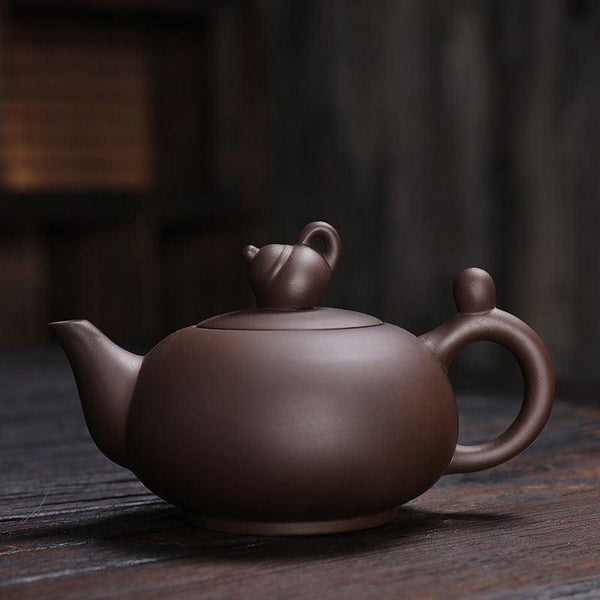
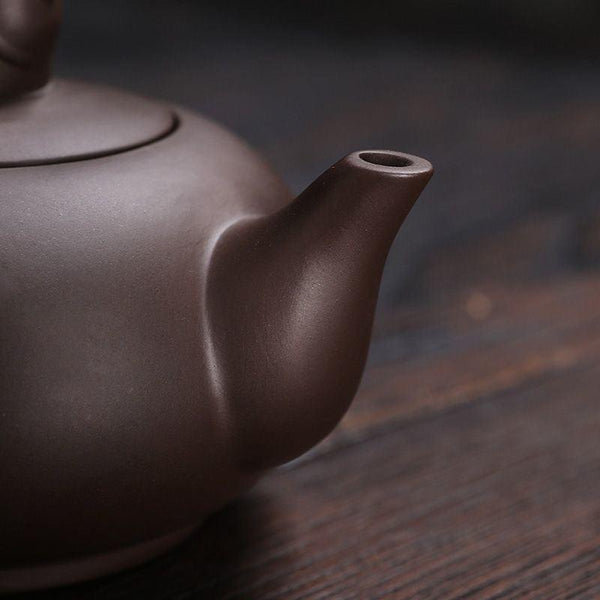
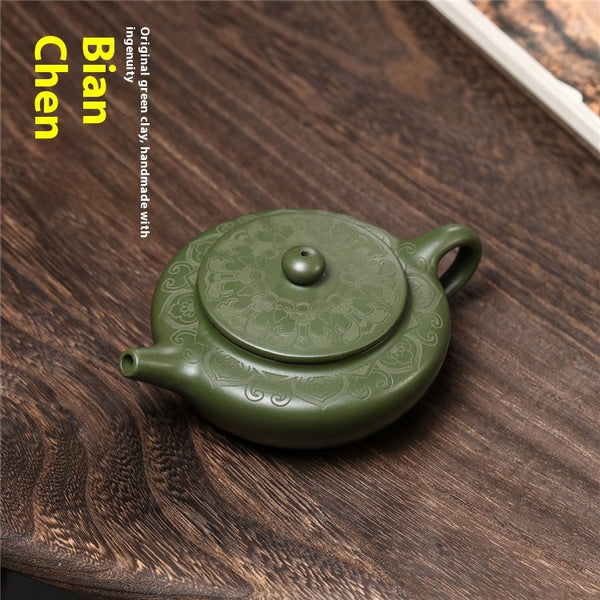
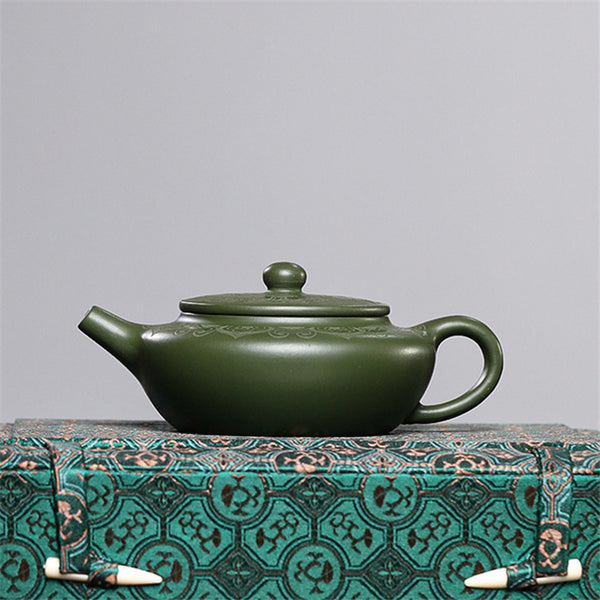
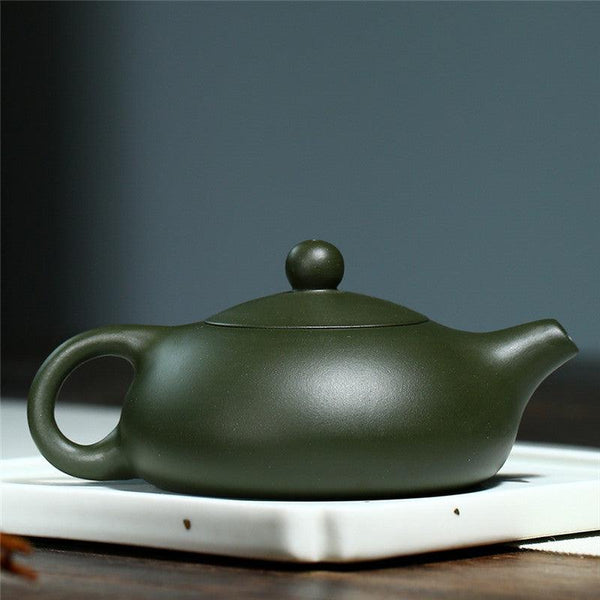
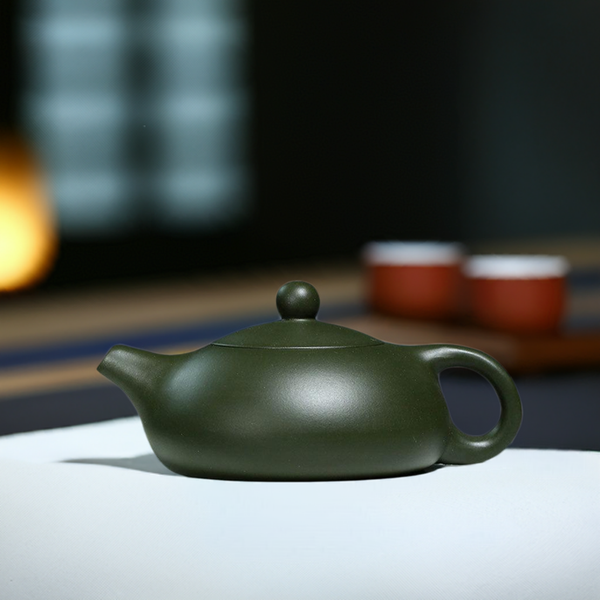
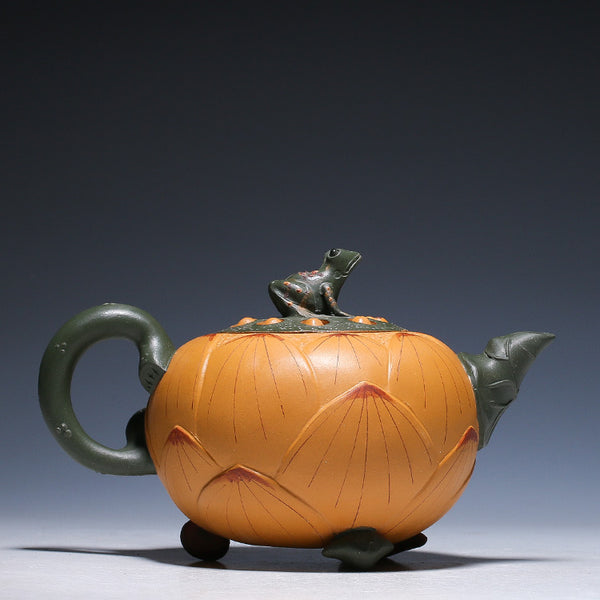
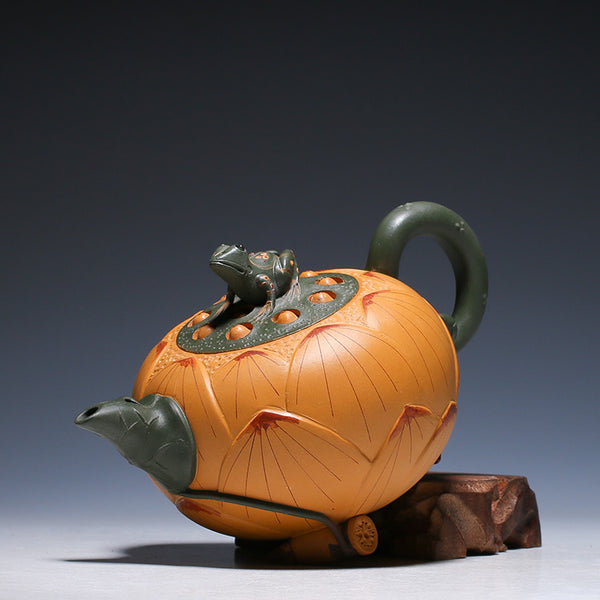
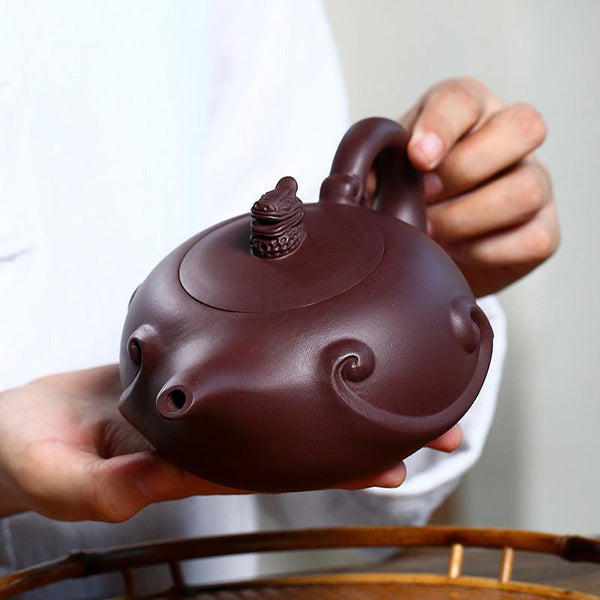
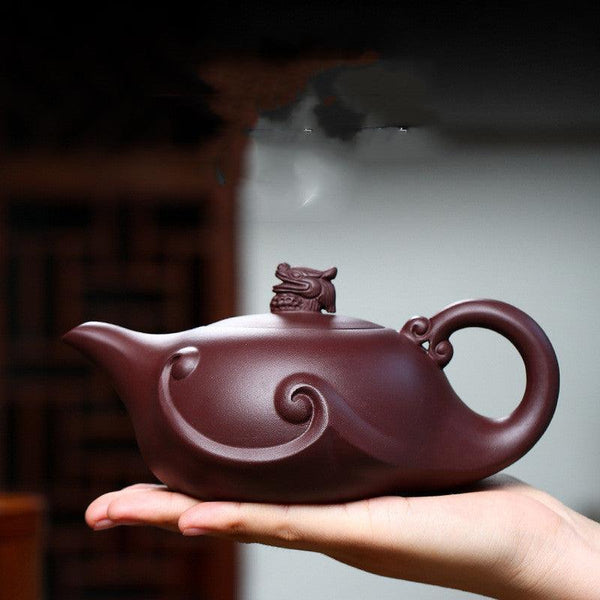
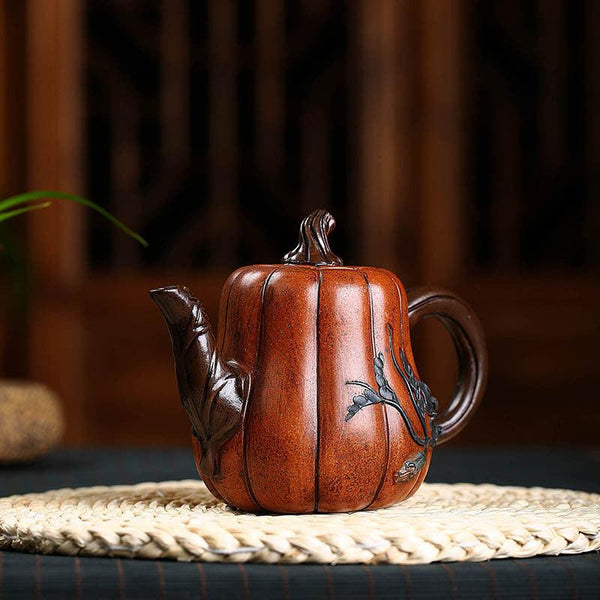
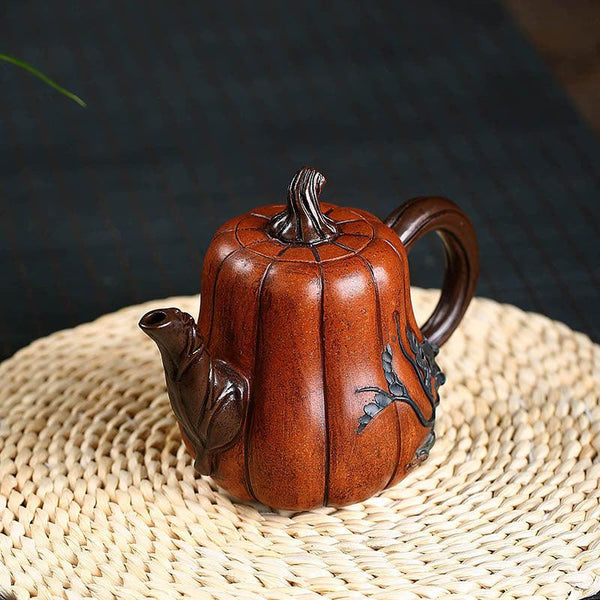
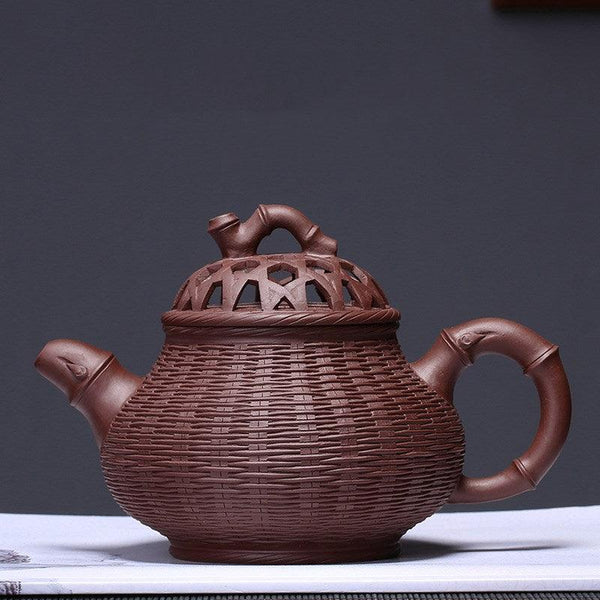
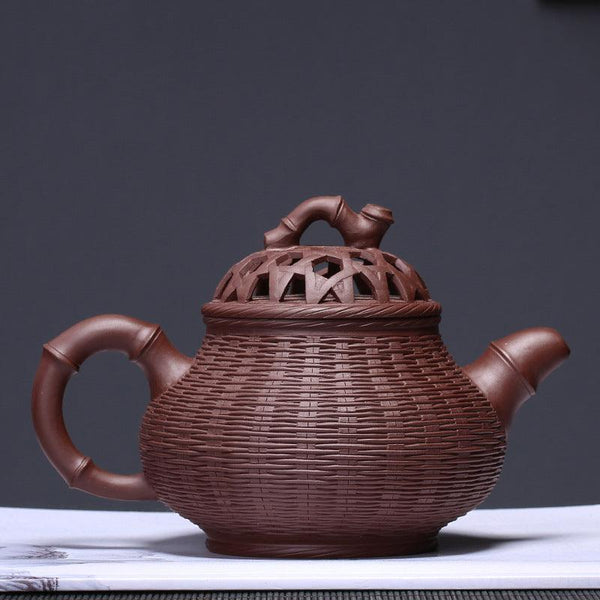
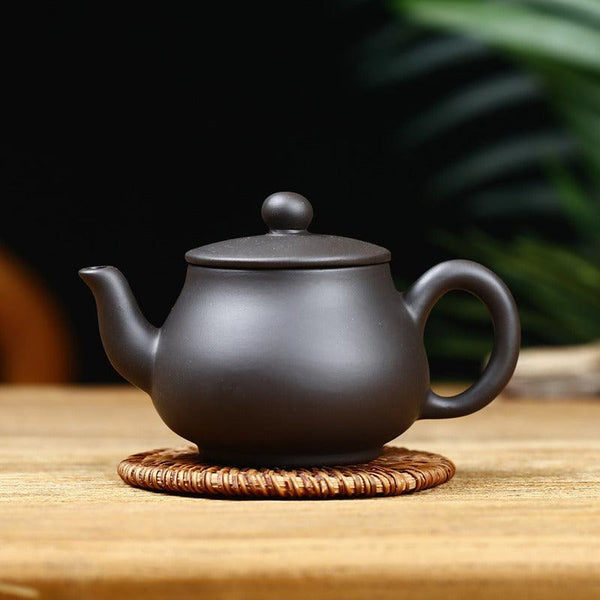
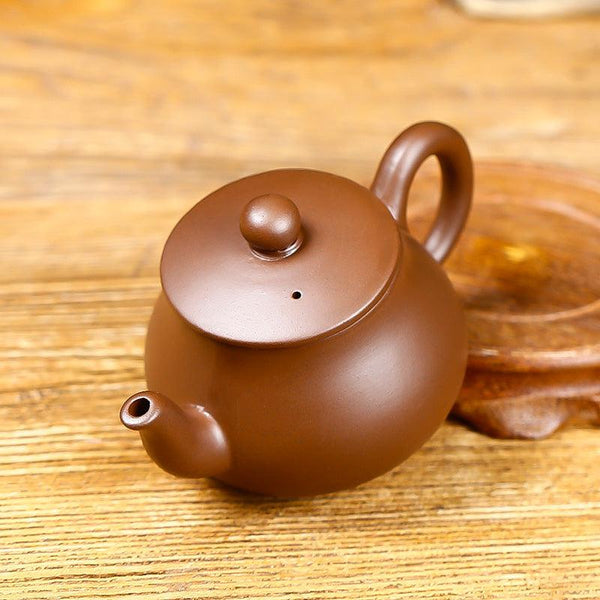
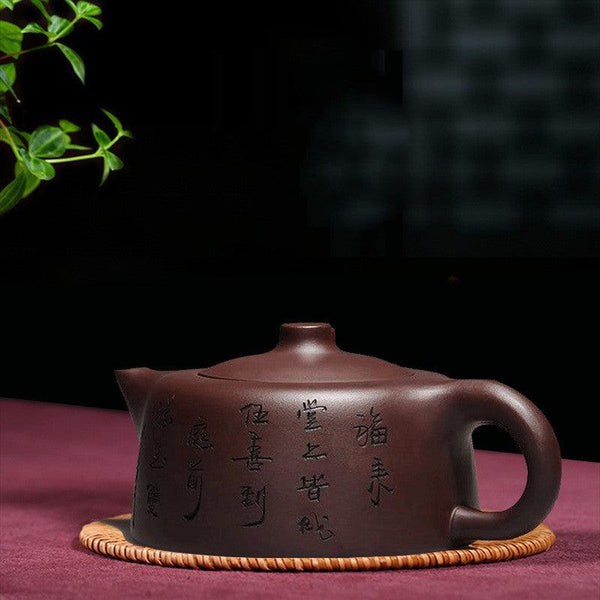
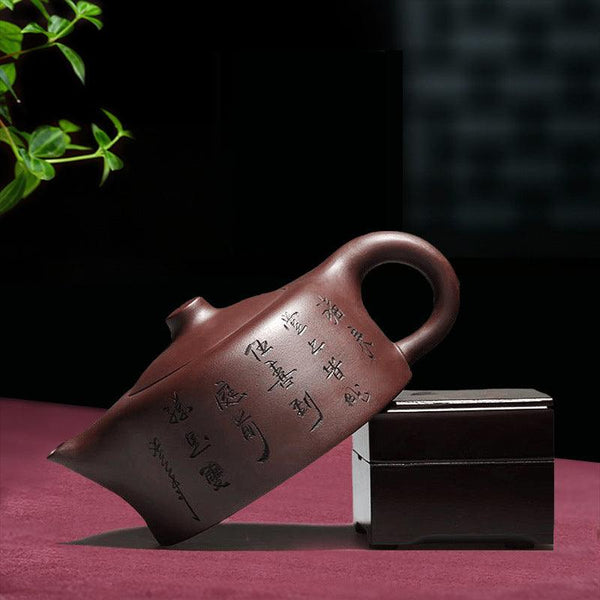
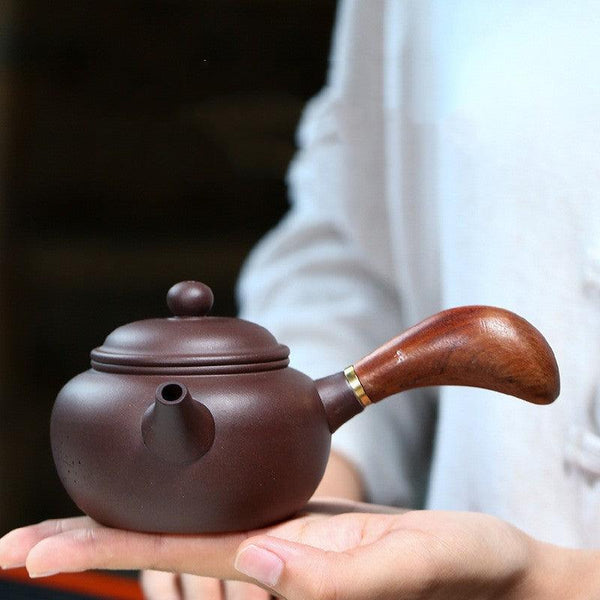
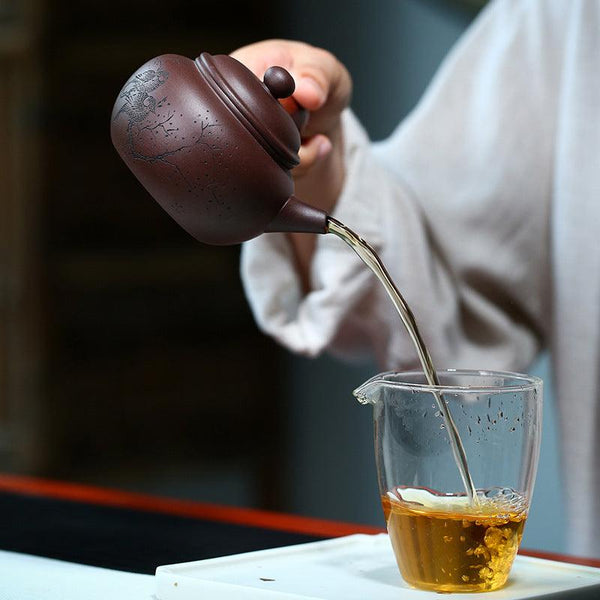
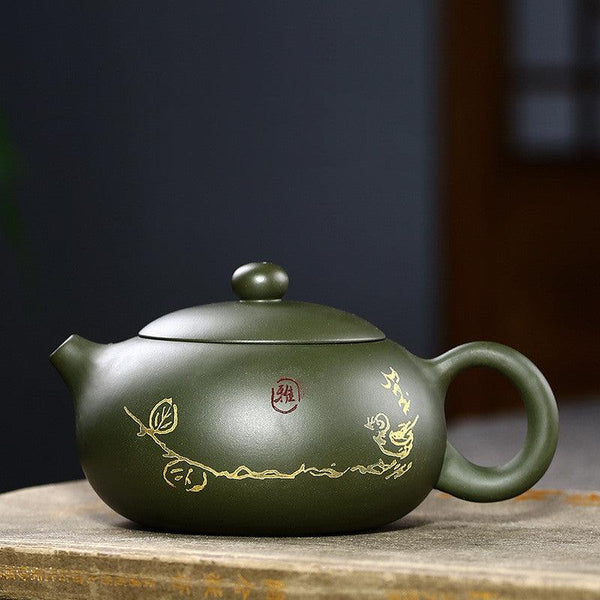
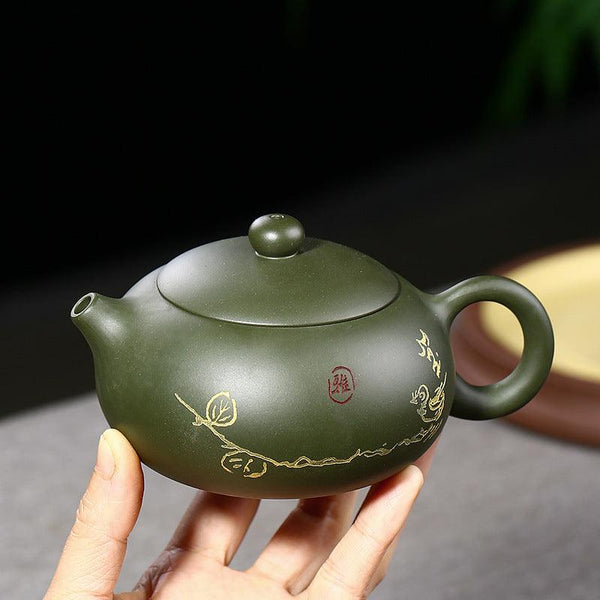
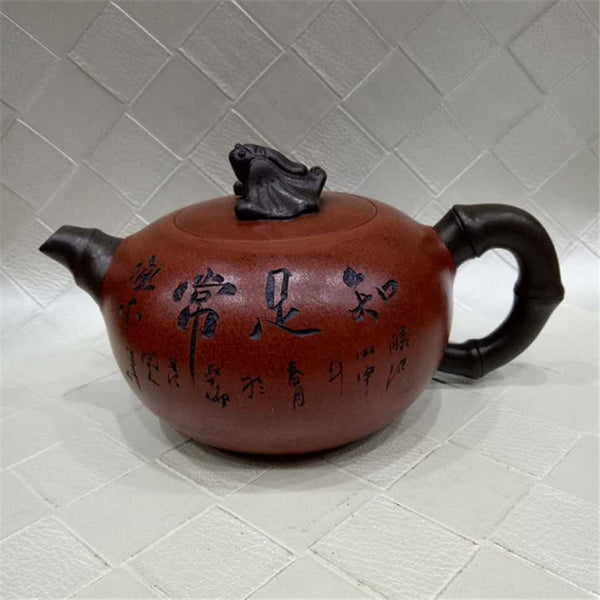
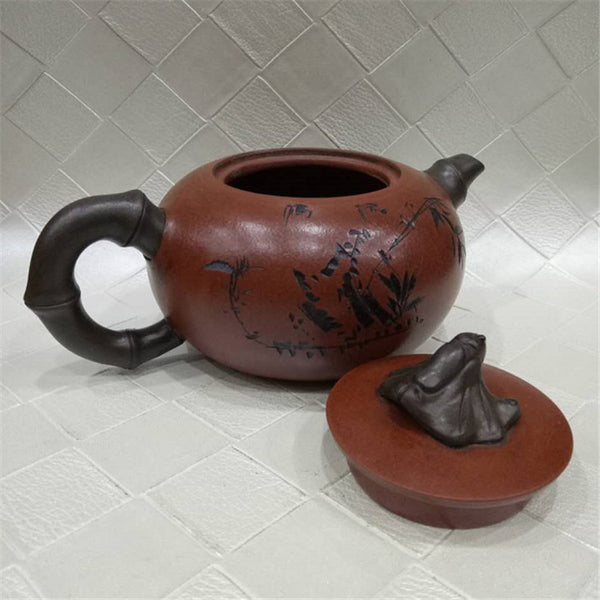
Pick up an unglazed, unadorned Yixing Zisha teapot and you feel the quiet beauty of pure mineral earth and architectural geometry. Pick up a finely engraved Yixing teapot, however, and the vessel becomes something more: a three-dimensional scroll where poetry, ink painting, calligraphy, and ceramic form converge in the palm of your hand.
In Chinese ceramic tradition, Zisha engraving (Tao Ke) is far more than surface decoration. Unlike painted porcelain, where cobalt or enamel pigments sit atop a glossy glaze, Yixing engraving cuts directly into the living clay body—using a steel or bamboo blade in place of a brush (yi dao dai bi). Through centuries of collaboration between master potters and China’s leading scholars, engraving transformed functional tea tools into treasured expressions of literati culture.

1. Origins of Zisha Engraving
Archaeological evidence traces Yixing clay vessels back to the Northern Song Dynasty, yet early Zisha teapots were primarily plain, utilitarian wares. During the Ming Dynasty, as Chinese tea culture shifted from whisking powdered tea to steeping loose leaves, Zisha teapots rose swiftly in popularity among China’s educated elite.
Engraving began quietly on the underside of the teapot rather than on its belly. According to Ming-era records in Yangxian Mingtao Lu, legendary master Shi Dabin initially invited skilled calligraphers to brush inscriptions onto his pots before cutting the characters with a bamboo knife, and later developed his own refined, understated carving style directly into the clay to sign his name and dates. By the early Qing Dynasty, Kangxi-era innovator Chen Mingyuan moved inscriptions from the hidden base onto the visible body of the vessel, carving short poetic verses alongside his square seal.
The true golden age of Zisha engraving arrived in the early nineteenth century during the Jiaqing and Daoguang reigns. Scholar-official and celebrated seal carver Chen Hongshou—better known by his courtesy name Chen Mansheng—became deeply fascinated by Yixing pottery while serving as a county magistrate near the kilns. Mansheng realized that simplifying busy shapes and replacing heavy relief or enamels with spacious, unadorned clay walls would allow literati poetry and calligraphy to shine. His collaboration sparked a cultural movement summed up by a classic saying in the tea world: "The teapot gains prestige from the calligraphy, and the calligraphy endures through the teapot."
2. Calligraphy, Landscape, and Poetry
A masterfully engraved Yixing teapot unites the classical "Four Arts" of Chinese literati life—poetry, calligraphy, painting, and seal carving—around a curved ceramic canvas.
- Calligraphy Across Scripts: Potters and carvers adapt classical brush scripts to clay. Archaic seal script (Zhuanshu) and clerical script (Lishu) lend dignified, bronze-like gravitas to structured teapots, while regular (Kaishu), running (Xingshu), and wild cursive (Caoshu) scripts capture fluid rhythm and personal emotion across rounded bellies.
- Botanical Motifs and Landscapes: Because Zisha clay naturally fires in warm earth tones—chestnut purple, cinnabar red, and golden Duanni—engraved imagery relies on line contrast rather than bright pigments. Favorite subjects include the "Four Gentlemen" of Chinese art (plum blossom, orchid, bamboo, and chrysanthemum), misty mountain retreats, pine trees beside scholars' rocks, and classic scenes of sages brewing tea outdoors.
- Inscriptions Matched to Form and Tea: Traditional Zisha inscriptions follow a guiding principle known as "matching the pot, matching the tea, and matching the person." A gourd-shaped vessel carries verses celebrating vitality; a straight-walled well-fence pot carries reflections on clarity and restraint. Each inscription invites quiet contemplation during a slow Gongfu tea session.
3. Different Engraving Techniques
Creating expressive brushwork with a sharp blade on fragile clay demands specialized timing, preparation, and knife discipline.
Timing: Greenware Engraving (Shengke) vs. Post-Firing (Shuke)
Almost all traditional artistic engraving is performed before kiln firing (Shengke), when the handmade teapot has dried to a firm, leather-hard stage. At this moisture sweet spot, a keen steel blade slices cleanly without tearing sticky clay or shattering baked ceramic. Conversely, post-firing engraving (Shuke) cuts into dense, 1180°C stoneware; because fired Zisha is extremely hard and prone to microscopic chipping, true hand carving on finished pots is rare today and mostly replaced by automated machines.
Three Approaches to Drafting
- Ink-Draft Carving (Kedi): The artist uses a traditional hair brush and ink directly on the unfired teapot to compose calligraphy or painting, then carves precisely along the ink strokes.
- Transfer Carving (Yinke): A detailed composition drafted on paper is traced or transferred onto the curved clay wall before carving begins.
- Freehand Carving (Kongke): The highest test of skill. Without a single pencil or brush guideline, the artist carves straight into the blank clay body freehand, adjusting composition, spacing, and stroke weight spontaneously with zero margin for error.
Two Fundamental Knife Methods (Daofa)
- Double-Knife Centered Method (Shuangru Zhengdao): Cutting carefully along both edges of a brushed line and clearing out the clay ridge in the middle, the carver achieves clean, crisp grooves with the authoritative texture of ancient stone stele rubbings.
- Single-Knife Angled Method (Danru Cedao): Tilting the blade at a controlled angle—often ground to a sharp ~45–47° bevel—the carver executes entire strokes in single decisive sweeps. Deep plunges create bold ink weight; lifted strokes taper into delicate dry-brush whispers.
Five Classic Surface Styles
Across workshops, carvers combine these cuts into five signature decorative effects: Qingke (clean, uncolored incised lines), Shadike (carving away and stippling the background into an uneven "sand ground" so raised characters stand out), Yangke (shallow relief carving where the background is scraped lower than the motif), Intaglio/Incised carving, and Zhaoseke (filling carved recesses with contrasting colored Zisha clay slips before firing so the artwork fuses permanently with the body).
4. Cooperation Between Potter and Scholar
Much of Zisha engraving's prestige stems from a uniquely collaborative creative model: the partnership between skilled ceramicists and cultured literati.
The archetype was set by Chen Mansheng and master potter Yang Pengnian (alongside fellow artisan Shao Erquan). Mansheng drew dozens of clean, architecturally poised vessel profiles—famously celebrated as the Eighteen Mansheng Styles—and passed them to Yang Pengnian to hand-paddle into clay. Once the greenware firmed up, Mansheng brushed and carved poetic inscriptions directly onto the pots. Finished pieces bore Mansheng’s studio seal, "Amantuo Shi," on the base and "Pengnian" tucked neatly beneath the handle.
Subsequent generations deepened this partnership:
- Qu Yingshao (Ziye) & Shen Xi / Ji'an: A scholar-painter famed for crisp ink bamboo, Ziye joined forces with Qing potters to produce the celebrated "Three-Perfection" (Sanjue) Shipiao teapots uniting extraordinary pot construction, bamboo painting, and poetic calligraphy.
- Wu Changshuo & Huang Yulin: Late-Qing painting giant Wu Changshuo inscribed bold, archaic brushwork onto finely potted vessels by master Huang Yulin.
- Modern Masters: In the mid-twentieth century, ceramic grandmaster Gu Jingzhou collaborated with celebrated Shanghai painter Wu Hufan as well as engraving titan Ren Ganting—one of Yixing’s "Seven Old Masters." Ren Ganting could famously paint symmetrical flowers and landscapes with either hand and trained a whole lineage of contemporary engraving masters, including Xu Xiutang, Tan Quanhai, Mao Guoqiang, Bao Zhiqiang, and Shen Hansheng.
5. How Engraving Changes the Composition
Adding calligraphy and imagery to a teapot is not like hanging a picture on a flat wall—it fundamentally alters the vessel's three-dimensional composition.
Early Yixing pots often relied on sculpted botanical reliefs, colored enamels, or intricate ribbing across the entire body. Literati engraving demanded the exact opposite: simplicity and open negative space (Liubai). To showcase brushwork properly, potters flattened shoulders, straightened conical walls, and stripped away distracting moldings—creating expansive, quiet "canvases" across forms like the Shipiao, Jinglan, and Hanwa.
Good engraving respects the teapot’s structural geometry:
- Round Shapes (Yuan Qi): Running script calligraphy and sweeping bamboo stalks echo the swelling arc of the belly, guiding the eye smoothly from the spout curve around to the handle.
- Square Shapes (Fang Qi): Crisp planar walls provide natural frames like hanging scrolls, pairing naturally with structured clerical script, seal script, and architectural landscapes.
Crucially, great composition never suffocates the clay. Because authentic Zisha is prized for its natural sandy grain, mineral richness, and ability to develop a deep, translucent jade-like patina through years of brewing, balanced negative space ensures that the engraved art and the living clay amplify each other rather than competing for attention.
6. Hand Engraving vs. Machine Engraving
As modern technology entered the pottery market, automated engraving tools made cheap decorated teapots widely available. Knowing how to distinguish authentic hand engraving from machine etching protects both aesthetics and brewing quality.
|
Feature |
Hand Engraving (Pre-Firing) |
Machine / Laser / Sandblasting |
|
Production Timing |
Carved in leather-hard greenware prior to high-temperature firing. |
Usually etched after kiln firing on hardened ceramic surfaces. |
|
Groove Depth & Profile |
Variable depths and widths; crisp V-shaped or angled knife valleys. |
Uniform, flat-bottomed channels or shallow, rounded "riverbed" pits. |
|
Edge & Stroke Character |
Dynamic entry/exit points, natural sand displacement, "stone" feel. |
Mechanical uniformity, identical character spacing, stiff lines. |
|
Impact on Clay Surface |
Preserves natural dual-pore wall breathability around the carving. |
Laser scorching can char clay and disrupt surface patina formation. |
What Hand Engraving Looks Like
Look closely at a hand-carved character under angled light. You will see deliberate variations in depth and width—a stroke might start sharp and shallow, plunge deeper at a turn, and taper crisply at the tail. Where the steel blade sliced through coarse quartz and iron-rich clay grains before firing, the groove walls carry a natural, rugged stone-and-bronze (Jinshi) character. Every repetition of the same character looks slightly unique, breathing with the rhythm of the carver's wrist.
Spotting Machine Alternatives
- Laser Etching: A computer-guided laser vaporizes a thin layer off a finished pot, leaving faint, completely flat, shallow depressions that feel lifeless and sometimes carry subtle dark scorch marks.
- Sandblasting: Workers apply a computer-cut vinyl stencil to a fired teapot and blast fine grit across exposed letters. The result shows rounded, uniform "riverbed" troughs with soft, fuzzy edges and zero directional knife cuts.
- Rotary / CNC Carving: Handheld micro-drills or CNC routers grind uniform-depth grooves with rounded ends, lacking the crisp entry angles and layered brushwork vitality of a traditional steel chisel.
7. How to Appreciate an Engraved Teapot
Evaluating an engraved Yixing teapot comes down to four harmonious standards that bridge art appreciation and everyday brewing function:
- Harmony Between Vessel and Theme: Does the engraving belong on that specific pot? A bold, archaic seal-script poem feels right at home on a dignified Square pot or tall Dezhong, while light, breezy bamboo brushwork complements the sharp triangles of a Shipiao. Oversized carvings crammed tightly against handles or spouts break the pot’s visual rhythm.
- Calligraphic Vitality and Negative Space: Judge the work as you would fine ink painting on paper. Are the strokes balanced, rhythmic, and alive? Does the layout leave thoughtful breathing room so the natural color and sandy texture of the clay remain the star?
- Expressive Knife Work (Daofa): Tilt the teapot toward a window and inspect how light catches the carved grooves. Authentic hand carving reveals confident transitions in depth, crisp intersections, and clean, expressive edges free of mechanical uniformity.
- Clay Integrity and Brewing Performance: Above all, an engraved Yixing teapot remains a functional brewing instrument. Because traditional greenware carving occurs before the clay sinters at ~1180°C, the surrounding vessel keeps its signature dual micro-pore structure—watertight yet gas-breathable. Just like a plain Zisha pot, a finely engraved teapot retains heat evenly, preserves tea aromatics and healthful catechins while softening bitterness, and slowly rewards daily brewing as tea oils polish both the clay surface and the carved strokes into a rich, cohesive patina.
Conclusion
Zisha engraving is where earth meets literature. When a master potter’s disciplined clay form meets a skilled carver’s knife-as-brush expression, a simple tea vessel becomes an enduring dialogue across poetry, painting, and tea—inviting you not just to brew a better cup, but to hold centuries of living scholar-craftsmanship in your hands.