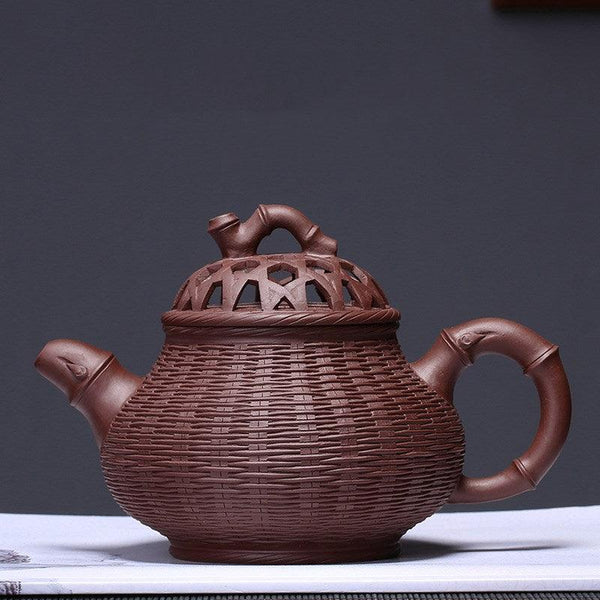
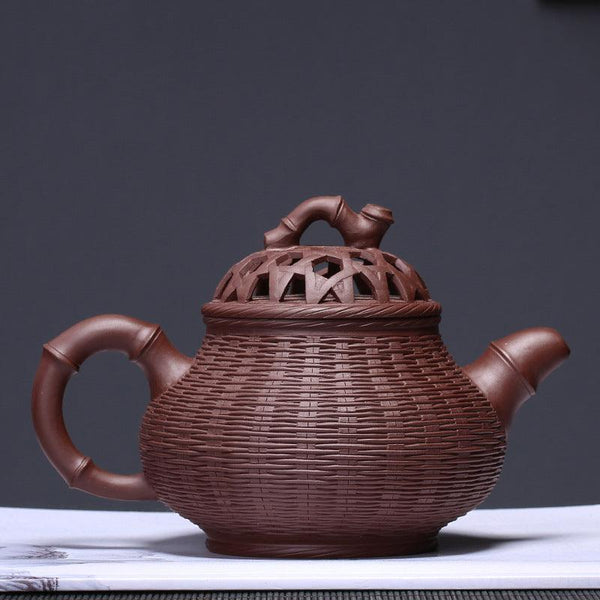
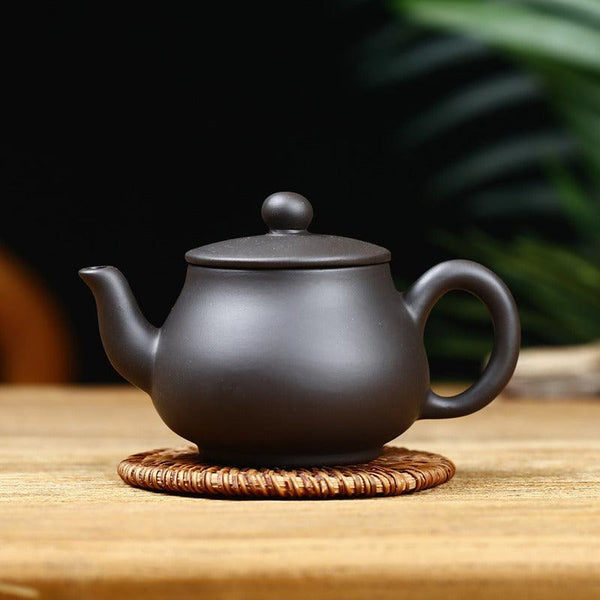
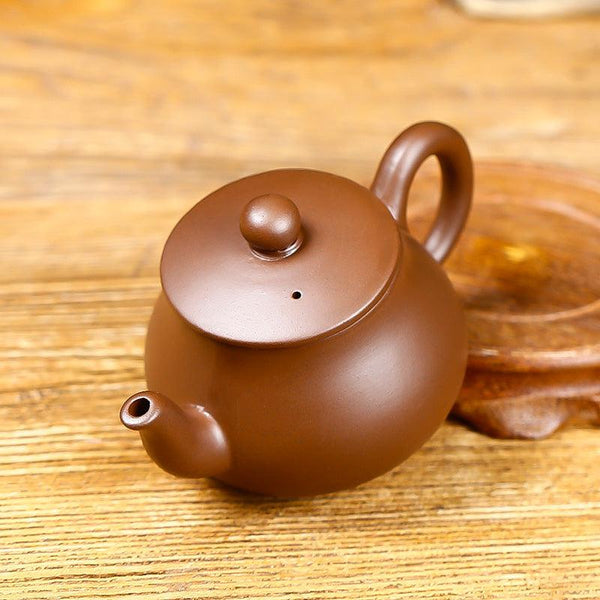
Turn over any authentic Yixing Zisha teapot, look closely inside the recessed rim of its lid, or inspect the small flare where the lower handle joins the body, and you will almost certainly find crisp, reddish-brown impressions pressed into the clay.
In Western ceramics, a maker’s mark is often little more than a functional factory stamp or a quick handwritten number. In Chinese Zisha culture, however, these stamped impressions—known as chops or seal marks —are deeply rooted in classical literati painting, imperial epigraphy, and gold-and-stone seal carving (Jinshi).
A seal mark records who built the vessel, whose studio supervised the firing, or which historical workshop commissioned the design. Yet in today's antique and tea markets, seal marks are also the single most misunderstood and frequently forged element of a teapot.
Understanding where seals appear, what archaic scripts they use, how they are pressed into leather-hard clay, and why a seal alone never guarantees authorship is essential knowledge for every serious tea drinker.

1. Where Seals Commonly Appear
Traditional Yixing teapots rarely carry just one mark in a single spot. Instead, artisans follow an established structural hierarchy, distributing stamps across four primary locations:
The Base Seal
The base seal on the bottom of the teapot is the most prominent and authoritative mark. Positioned directly in the center of the foot ring or flat base, it is usually the largest seal on the vessel. Historically, it carries the full name of the master potter, the name of their private studio, a factory mark, or a prestigious commissioning inscription.
The Lid Seal
Lift the lid and look on its inner surface. Inside the circular inner collar (Zikou) or stamped directly into the concave ceiling of the lid, you will usually find one or two small, neatly stamped seals. Because space is limited, lid seals typically show only the maker’s given name (such as Jingzhou for master Gu Jingzhou) or a pair of tiny stamps displaying the family name on one side and the personal name on the other.
The Handle Seal
Examine the base of the handle where it anchors to the lower belly of the teapot. Underneath this subtle curve—known as the handle terminal (Ba Shao)—artisans frequently press a miniature square, oval, or gourd-shaped chop. Like the lid seal, it usually bears a single character (often the maker’s surname) or a personal workshop emblem.
The Interior Wall Seal
On fully handmade teapots (Quan Shou Gong), potters often stamp an impression directly onto the flat clay strip before rolling and paddling it into a hollow cylinder. When you look inside the empty pot through the mouth opening, you may see this stamp on the interior chamber wall. Because it was stamped onto a flat sheet and subsequently curved during paddling, an authentic inner-wall seal exhibits subtle, organic tension and stretching in the clay grain.
2. Name Seals, Studio Seals, and Place Seals
The inscriptions found within Yixing stamps fall into several distinct categories, each telling a different part of the teapot’s history:
- Personal Name Seals (Xingming Zhang): These record the craftsman who shaped the pot. Examples range from Qing dynasty legends like Chen Mingyuan, Shao Daheng, and Yang Pengnian, to twentieth-century masters like Gu Jingzhou, Jiang Rong, and Zhu Kexin. They may read "Made by [Name]" ([Name] Zhi / [Name] 制) or simply state the craftsman's art name.
- Studio and Chamber Seals (Zhaihao / Tanghao Zhang): Scholars, literati officials, and prominent studios often commissioned pots stamped with their hall names rather than an artisan’s personal name. The most famous example is "Amantuo Shi", the studio hall mark of nineteenth-century scholar-official Chen Mansheng. Other famous historic workshop names include Yigu Zhai and Tiehua Xuan.
- Place and Regional Seals (Diming Zhang): Inscriptions such as "Yixing, China" or archaic historical names like "Jingxi" or "Yangxian" identify the geographic origin of the pottery.
- Commemorative and Award Seals: Certain historic masters marked their pieces with records of significant achievements. For instance, master Cheng Shouzhen famously stamped his late-period Duoqiu teapots with an elaborate 24-character base seal commemorating the premier award his design won at the 1915 Panama-Pacific International Exposition in San Francisco.
3. Seal Script Basics for Beginners
To modern Western eyes—and even to many native Chinese speakers—the characters inside a Yixing seal mark can appear bafflingly abstract. That is because teapot stamps almost exclusively use Seal Script (Zhuanshu), an ancient family of Chinese calligraphic scripts that predate modern standard characters by more than two thousand years.
Why Use Seal Script?
Seal script features stately, balanced, geometric lines that feel architectural and timeless. Because it originated as an incised script carved into bronze vessels, stone steles, and imperial jade seals, its structured aesthetics harmonize naturally with the unglazed mineral surface of fired Zisha clay.
Relief (Yangwen / Zhuwen) vs. Intaglio (Yinwen / Baiwen)
Teapot stamps are cut by seal carvers using one of two methods:
- Relief / Red Characters (Yangwen): The carver cuts away the negative space around the strokes. When stamped into clay, the background is pushed downward, leaving the characters raised above the surface. This is by far the most common format in Yixing teapots.
- Intaglio / White Characters (Yinwen): The carver incises the lines of the characters directly into the seal face. When stamped, the text is pressed into the clay as recessed grooves surrounded by a flat border.
Reading Direction
Traditional seal marks follow classical Chinese reading conventions: from top to bottom, and from right to left. A four-character square seal is read starting in the upper-right corner, moving down to the lower-right, then jumping to the upper-left, and finishing in the lower-left.
4. How Seals Are Pressed into Clay
A crisp, sharp seal mark is not stamped onto a finished teapot after it comes out of the kiln. It must be stamped while the teapot is still unfired raw clay—a delicate step requiring precise timing and mechanical support.
The "Leather-Hard" Window
Seals are pressed when the sculpted green body (Shenpi) reaches the leather-hard stage. If the clay is too wet, it sticks to the stamp face, tearing away mineral grains and smearing the edges. If the clay is allowed to dry too much, the downward pressure of the stamp will crack the brittle walls.
The Internal Anvil (Dingzhu)
A hollow, thin-walled clay teapot cannot withstand heavy downward force without caving in. To stamp the base seal, the potter inserts a specialized brass or hardwood post—known as a top-pillar or anvil (Dingzhu / 顶柱)—through the mouth opening to brace the interior bottom floor.
Holding the stamp perfectly perpendicular, the artisan applies firm, uniform body weight downward in a single decisive press. If the pressure wobbles, the seal impression will be unevenly deep on one side; if the internal post shifts, the bottom of the pot can deform.
Microscopic Clay Displacement (Nimen)
As the hard stone, horn, or boxwood chop sinks into the damp clay, it compresses the local mineral matrix, pushing fine clay slurry outward and displacing coarse sand grains around the perimeter of the impression. Under a magnifying loupe, genuine stamped marks show crisp, sloping groove walls and natural compaction ridges (Nimen) that distinguish them from modern laser-etched replicas.
5. Why One Teapot May Have Several Seals
It is common to find three or four distinct seals on a single handmade teapot. This multi-seal convention reflects traditional Chinese workshop etiquette, aesthetic balance, and a long history of cross-disciplinary collaboration.
The Classic Three-Position Ensemble
In standard master pottery, the base, lid, and handle form a cohesive signature ensemble:
- The base seal provides the formal public signature (the master's full name or studio).
- The lid seal confirms that the lid was individually shaped and fitted to that specific pot.
- The handle seal provides a quiet artisan hallmark balanced along the handle’s vertical axis.
The Scholar-Potter Collaboration
During the Qing dynasty, the rise of literati teapots introduced cooperative signatures. On an authentic Mansheng teapot, the base carries Chen Mansheng’s studio seal (Amantuo Shi), while the underside of the handle and the inside of the lid carry the personal seal of potter Yang Pengnian (Pengnian), and the body carries the carved signature of the scholar who inscribed the poem.
Rather than signaling conflicting ownership, multiple seals record a harmonious partnership between designer, craftsman, and calligrapher.
6. Why a Seal Alone Cannot Prove Authorship
Among vintage pottery collectors, there is an old saying: "Chop marks are easily forged, but clay, spirit, and workmanship cannot be faked".
Relying solely on a seal mark to verify a teapot's maker is the most common mistake made by new buyers. Here is why:
1. Real Seals on Fake Pots (Zhen Yin Jia Hu)
Historically, when a famous master passed away, their personal carving chops often remained behind in family workshops or were acquired by third-party dealers. Throughout the late Qing dynasty, the Republic period, and modern times, unscrupulous workshops have stamped authentic antique master seals onto poorly made, mass-produced teapots.
2. Generic Historical Homage Marks
In southern Chinese and Southeast Asian tea trade history, certain famous names became generic quality labels rather than literal maker claims. Millions of small, red-clay Chaozhou and Yixing gongfu teapots made across the nineteenth and twentieth centuries bear base seals reading "Jingxi Hui Mengchen Zhi" (Made by Hui Mengchen of Jingxi). These pots were never meant to deceive buyers into thinking seventeenth-century master Hui Mengchen was alive; the chop functioned as a widely recognized hallmark for classical horizontal-pour pots.
3. Modern Digital Replication
Today, a high-resolution photograph of a museum master seal can be imported into computer design software in seconds. Computerized CNC milling machines and photo-chemical etching can duplicate the exact stroke contours of an ancient seal down to fractions of a millimeter.
Therefore, an authentic seal mark is merely a starting clue. True authentication requires examining the entire teapot: the authentic sandy grain and breathability of the clay, the hand-crafted inner seams, the precision fit of the lid, the balance of the spout and handle, and the natural jade-like patina (Baojiang) developed through real brewing.
7. How to Record and Research a Seal
If you own or encounter a Yixing teapot with an intriguing seal, you can document and decipher it using traditional and digital methods:
Step 1: Capture a Clean Impression
Soft Modeling Putty / Kneaded Eraser: Gently press clean artist’s kneaded eraser or non-staining silicone putty into the recessed mark and peel it away cleanly. This creates a raised, easy-to-read reverse relief that reveals subtle knife strokes without risking clay abrasion.
Raking-Light Macro Photography: Clean all dry tea dust out of the seal with a soft, dry camel-hair brush. Position a single light source at a low, sharp angle across the base so shadows fall into the grooves, and photograph the mark in high resolution.
Paper Rubbing (Taoyin): For shallow marks, experienced collectors place thin xuan rice paper over the seal and gently tap it with a dry, lightly inked cotton dauber, creating a traditional black-and-white print of the characters.
Step 2: Decipher the Seal Characters
Consult a classical Chinese Seal Script Dictionary (Zhuanshu Zidian), or upload the high-contrast image to specialized digital epigraphy databases. Pay attention to archaic character variants and radical simplifications unique to stone carving.
Step 3: Cross-Reference Authoritative Catalogues
Compare your seal impression against verified reference marks in published master registers (Yinpu) and official museum catalogues—such as collections published by the Palace Museum in Beijing, the Shanghai Museum, or the Yixing Ceramics Museum.
When comparing dimensions, always keep kiln firing shrinkage in mind: because raw Zisha clay contracts by 10% to 15% (and up to 25% for rare Zhuni red clay) inside the kiln, an impression stamped into clay will always measure noticeably smaller than the physical seal stone that created it
Conclusion
A seal on an authentic Yixing teapot is much more than a maker’s trademark. It is a miniature work of classical epigraphy—a tiny window into centuries of Chinese literati aesthetics, kiln engineering, and workshop lineage.
When you look beyond the romance of the name and evaluate the seal alongside the quality of the clay, the balance of the form, and the soul of the craft, you unlock the true story that the potter pressed into the earth centuries ago.